
When Big Services Go Down (YouTube, WhatsApp & Co.) — and What They Teach About Status Communication

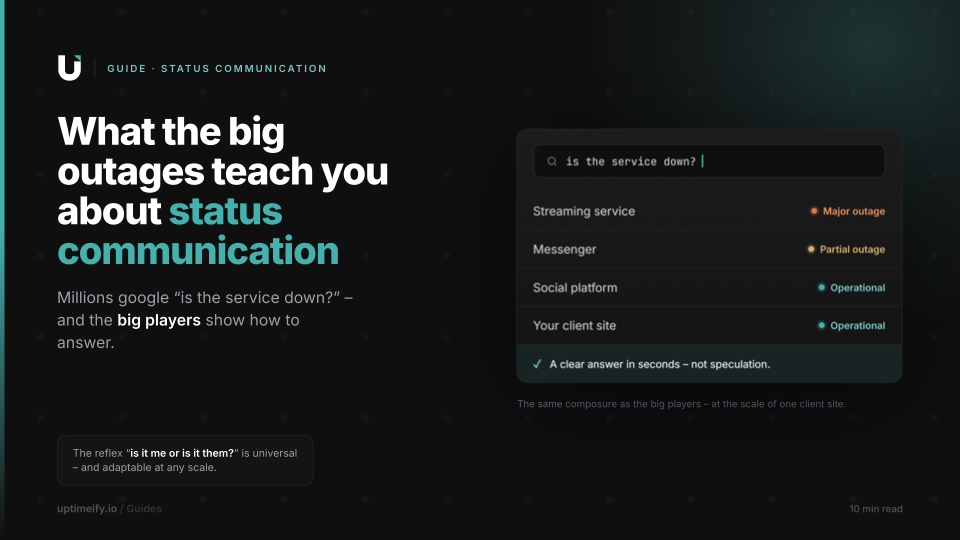
When WhatsApp won't load, YouTube stalls, or Twitch goes dark, nearly everyone does the same thing: googles "service server status" or "is service down." That search is a reflex — and it says something important about trust online. Millions of people, during an outage, want to know one thing above all: is it me or is it them? How the big services answer that question is a masterclass in status communication — and the best part: any agency can adopt the same patterns at small scale for their client sites. This article shows what the giants get right and how you adapt it.
The reflex to check the server status
It's worth pausing on user behavior, because it's the key to the whole topic. The moment a familiar service stops working, a small unease sets in — and the first impulse isn't anger but a question: is it my device, my Wi-Fi, my account — or is the service itself down? That uncertainty is uncomfortable, and people want to resolve it fast.
So they google the server status. The search impulse "is it down?" is, at heart, the search for certainty and for the feeling of not being alone with a problem. If the user finds a clear answer — "yes, it's on us, we're on it" — the unease vanishes almost instantly, even if the service still isn't back. If they find nothing, the uncertainty grows into frustration. That dynamic is exactly why status communication is so powerful: it turns uncertainty into certainty, and that's often more valuable than the quick fix itself.
What the big services get right
Large providers have learned from millions of such moments and developed a repertoire of communication patterns that kick in routinely during an outage. Four of them are especially instructive — and all four are independent of company size.
Pattern 1 — The clear overall status. At the very top of every professional status page sits a single, unambiguous statement: all operational, partial outage, or major outage. That one line answers most visitors' question in seconds, without them reading anything. Color and wording are unambiguous, not technical.
Pattern 2 — Honest updates instead of silence. The giants don't wait until everything's fixed to give an all-clear. They communicate in stages: issue detected, cause narrowed down, fix underway, resolved. Each update is short, honest, and timestamped. That regularity takes the menace out of the situation, because the user sees someone working on it continuously.
Pattern 3 — Plain language. Professional status updates skip the internal machinery. No stack trace, no internal system name, no blame on a supplier. The reader is the end user, not the engineer — and they should understand what's happening, not be impressed.
Pattern 4 — Separation of outage and maintenance. Planned work is announced and marked as maintenance, not an outage. That distinction is decisive: announced maintenance reads as a sign of diligence, while the same downtime without notice looks like a loss of control.
Why these patterns work — the psychology behind them
These four patterns aren't accidental — they're a response to human psychology during an outage. Understand them and you can deploy them deliberately instead of just imitating them.
At the core is the need for control. An outage strips the user of control over something they rely on — and uncertainty amplifies that feeling. Each of the four patterns gives a piece of control back: the clear overall status answers the most pressing question immediately. The regular updates replace speculation with facts and provide a rhythm the user can hold on to. The plain language ensures the message lands instead of confusing. And the separation of maintenance from outage takes the fright out of planned work.
The striking part: none of this shortens the actual downtime. The patterns don't change how long something is broken, only how it's experienced. And that experience determines trust. Two identical outages — one well communicated, one kept quiet — leave completely different impressions. That's exactly why the giants invest so much in this side of their operation.
How an agency adapts this at small scale
Now the key step: these patterns aren't reserved for global corporations. They scale down as well as they scale up, because they rest on psychology, not budget. An agency looking after a single client site can offer exactly the same composed status communication — the only difference is the number of onlookers.
Concretely: each client site gets its own branded status page under the client's brand. The clear overall status arises automatically when the page is coupled directly to real monitors — the displayed status comes from actual check results, not manual upkeep. At Uptimeify every outage is confirmed from multiple EU locations before it shows as an incident, so the display is reliable and produces no false alarms. For the honest updates you use the same fixed flow as the giants — detected, narrowed down, resolved — just for one client instead of millions. The plain language is free anyway; it's a matter of attitude, not technology. And the separation of outage and maintenance the platform handles for you: a planned maintenance window suppresses alerts and shows the service as "Maintenance" instead of an outage.
The result is remarkable: a small shop's client experiences the same composure during an outage that they know from the world's largest services. For an agency, that's a strong differentiator — the professionalism of the giants applied to the personal care only a small partner offers.
The EU angle: where the status data sits
One point the global services rarely address is especially relevant for an agency with European clients: where the status page's data is processed. Once a status page runs publicly, it's a website like any other in data-protection terms — and the processing location of its data becomes a fair question.
Here European agencies have an advantage the global providers often can't offer. An EU-hosted status page whose status data comes exclusively from European locations keeps both storage and collection in the European legal area. At Uptimeify the polling runs from six European locations, and the platform is EU-hosted. For you that simplifies the data-protection classification toward your client into a factual, verifiable statement — not a guarantee seal, just a location.
That closes the circle: you offer your client not just the giants' composed status communication, but also a clean answer to the data-protection question that a global corporation on US infrastructure can't give so easily. The giants' lesson, adapted and topped with a European advantage.
From someone else's outage to your own strength
The real value of this topic lies in a shift of perspective. The next big outage, where half the country googles "is service down," isn't a distant corporate affair — it's a case study you can learn from directly. Watch how professional services communicate: the clear status, the calm tone, the honest stage-by-stage updates. All of it is a handbook the giants wrote for you.
The conclusion is simple: outages are inevitable, for the largest players and the smallest client site alike. What differs isn't whether something goes down, but how composedly it's talked about. The big services have proven that good status communication can turn an outage into a moment of trust. These patterns are openly visible, free to study, and just as effective at small scale. Adopt them for your client sites and, when it counts, you offer exactly what every user is looking for when they check the server status: the reassuring certainty that someone has things under control.
Frequently asked questions
How do I check whether a service like YouTube or WhatsApp is down right now?
Most reliably via the provider's official status page, which shows the current operational status of each component. On top of that, third-party sites that aggregate user reports, and a search for the service name plus "down," give a quick sense of whether a problem is widespread or only affecting you. If it's widespread, it usually shows up in both sources within minutes.
Why do big services have their own status page?
Because during an outage a status page does two things at once: it channels millions of support requests to a single, well-maintained source of information, and it signals composure by transparently showing what's happening and that it's being worked on. Without that page, every outage would trigger an uncontrolled wave of inquiries, speculation, and rumors.
What makes status communication professional?
Four patterns: a clear, immediately understandable overall status; honest, regular updates along a fixed flow instead of silence until resolution; plain language with no internal jargon; and a clear separation between an unplanned outage and announced maintenance. These patterns are standard at the big services — and they transfer one-to-one to a single client site.
Can a small agency offer the same status communication as large corporations?
Yes — the patterns are the same, only the scale is smaller. A branded status page fed automatically from real checks, with a clear overall status and honest incident updates, is just as achievable for a single client site as for a global corporation. The difference isn't professionalism, only the number of users watching.
Where should the status page be hosted if I have European clients?
Within the EU, so the processing of the status data stays in the European legal area. At Uptimeify the platform is EU-hosted and checks exclusively from European locations. For agencies with European clients, that simplifies the data-protection classification, because storage and collection of the status data don't leave Europe.

Co-Founder of Uptimeify, responsible for all of marketing. He bridges technical development and marketing strategy — from Java, PHP and Shopware plugins to steering digital growth strategies. A certified UX Manager (IHK) and digital-marketing advisor to three non-profit organizations.
More from the blog
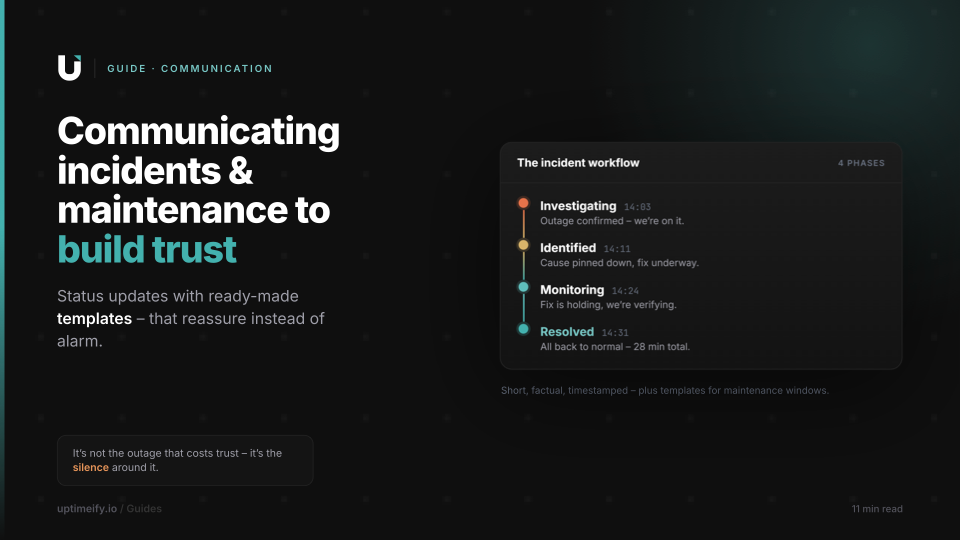
Communicating Incidents & Maintenance Windows: Status Updates That Build Trust
Templates for incident and maintenance communication that reassure the client instead of alarming them — from the first update to the all-clear.
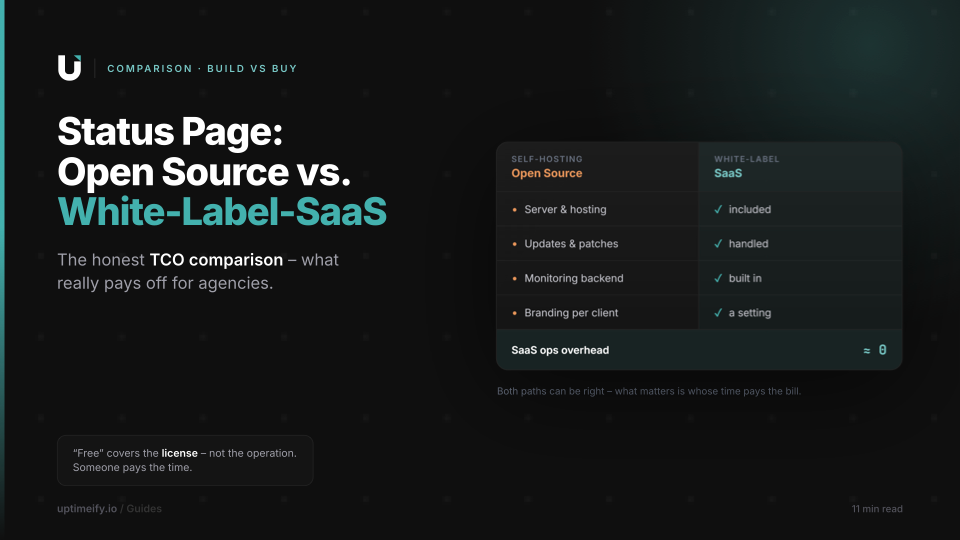
Status Page: Open Source vs. White-Label SaaS — What's Worth It for Agencies?
An honest TCO comparison: what a self-hosted open-source status page really costs — versus a ready-made, branded white-label solution for agencies.
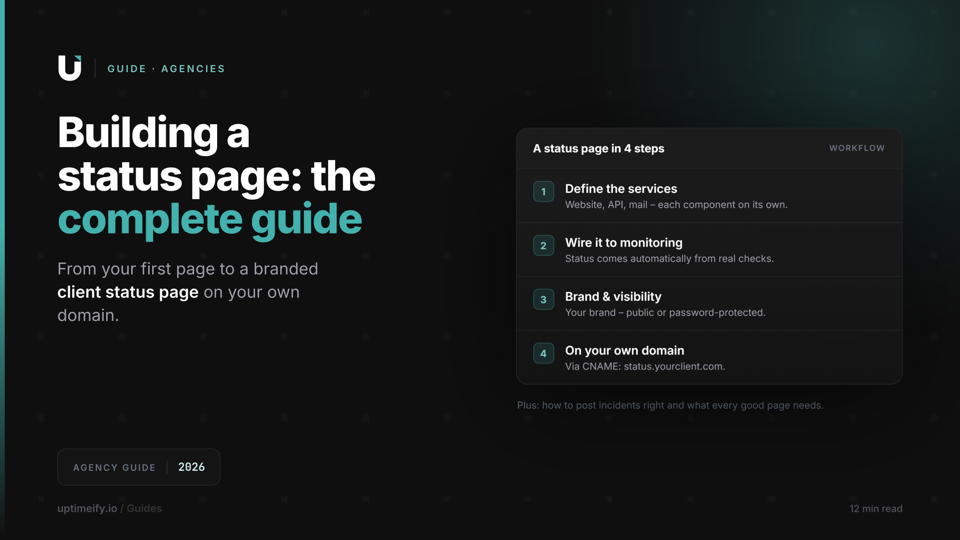
How to Create a Status Page: The Complete Guide for Agencies (2026)
From your first status page to a branded client status page: what to communicate, how to post incidents, and how to run a status page on your own domain.